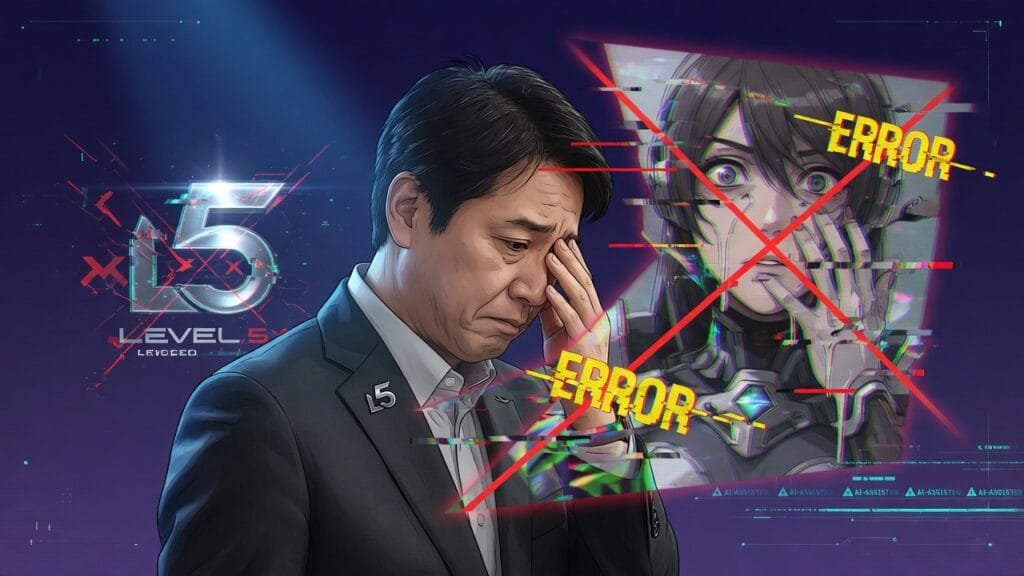
LEVEL-5 CEO and president Akihiro Hino issued a public apology on September 12, 2026 after backlash over artificial-intelligence processing in footage shown during the LEVEL-5 VISION 2026 II showcase. Power Up Gaming translated and summarized the note; Kotaku US and Automaton JP also circulated the clarification. Hino said AI was used on event footage as an experiment meant to make the presentation more spectacular, and he apologized to viewers who found that approach uncomfortable.
The clarification is careful about what is — and is not — changing in shipped products. Hino said scenarios, character designs, and fundamental settings remain human-authored. He also said shipped games will not include “simple” or casual AI output data as finished content. That is not a claim of zero AI anywhere in the pipeline; this desk will not write that LEVEL-5 has banned all AI from shipped games. Automation for tedious technical work is still described as a way to free staff for core design quality.
Separately, Hino framed LEVEL-5’s push to compress major-title development from roughly five years toward two as an ongoing trial-and-error plan, not a hard street-date mandate for any individual title. This filing will not convert that planning language into calendar locks. We also will not inventory which trailers or titles supposedly contained AI artifacts; the apology on record is about showcase/event footage and the studio’s broader AI experiment stance.
For catalog context without overreach, LEVEL-5’s known pipeline still includes long-running brands such as Professor Layton work already covered on this site — for example our live note that a Layton Curious Village remake is aimed at 2027 multiplat — but that mention is pipeline adjacency, not a claim those trailers were the AI material at issue. Industry readers comparing studio AI messaging can also look at other live AI-disclaimer coverage on rcg.news.
Bottom line for Saturday’s AM desk: LEVEL-5 apologized for AI-processed VISION 2026 II event footage, restated human ownership of scenarios and designs, promised shipped games will avoid simple/casual AI output, and kept the five-to-two-year compression language in trial-and-error territory. Primary outbound is Power Up; Kotaku or Automaton remain acceptable secondary cites in the body for readers who want additional English or Japanese framing.